
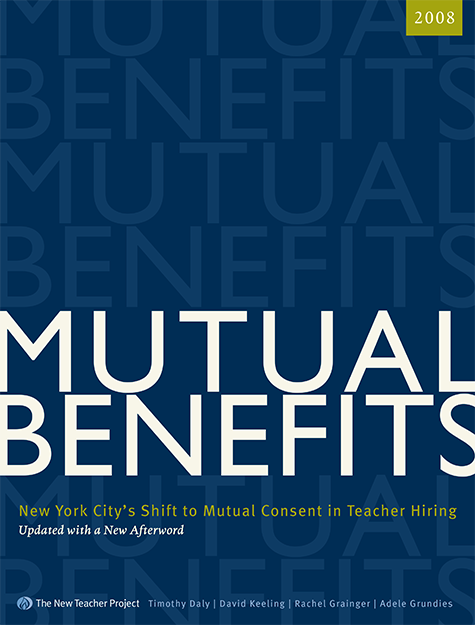
Published in April 2008, Mutual Benefits: New York City's Shift to Mutual Consent in Teacher Hiring examines the impact of New York City's 2005 school staffing policy reforms on teachers. These reforms replaced rigid staffing rules that often gave teachers and principals little or no input over teacher placements with a more open policy that required the “mutual consent” of both teachers and principals in all teacher hiring decisions.
- View links to media coverage of Mutual Benefits
- Read TNTP's statement on the ongoing debate over Mutual Benefits (May 5, 2008)
- NEW: Read TNTP's call for solutions (May 8, 2008)
Downloads
- Policy Brief (PDF 329K)
Mutual Benefits: New York City's Shift to Mutual Consent in Teacher Hiring
By Timothy Daly, David Keeling, Rachel Grainger and Adele Grundies (2008) - Press Release (PDF 99K)
Download Adobe Acrobat Reader here.
Executive Summary
In 2005, the New York City Department of Education (NYCDOE) and its teachers union, the United Federation of Teachers (UFT), agreed to a groundbreaking contract that reformed outdated school staffing provisions. Specifically, the new contract changed the staffing process for teachers and schools in three major ways. First, it protected the right of schools to choose which teachers they hired, regardless of seniority. Second, it ended the “bumping” of novice teachers out of their positions by senior teachers who claimed these positions based on seniority and without input from principals or school staffs. Finally, it established a more open hiring process for “excessed” teachers (those displaced from their positions because of falling school enrollments, budget declines, programmatic changes, or school closures).
In short, the 2005 contract saw New York City transition from a system in which teachers and principals often had no input over teacher assignments to a system of “mutual consent,” in which both teachers and principals had to agree on all teacher placements. This policy shift brought to a halt the pervasive forcing of teachers on schools and of schools on teachers, trends that had tarnished the city’s staffing system. Viewed through the lens of effective school staffing practices, it was a significant step forward.
The mutual benefits of mutual consent
As this paper illustrates, the mutual consent system has resulted in mutual benefits for teachers and schools by offering better choices, increased flexibility and greater transparency throughout the staffing process. The positive impact of this policy shift on New York City teachers is especially noteworthy. This study finds that the mutual consent system has:
- Earned strong support from New York City teachers: Mutual consent policies prioritize school fit and teacher and principal choice in the staffing process. In a 2007 survey, 87 percent of transfer teachers and 82 percent of excessed teachers agreed that it was important whether the principal of the school where they sought a new position wanted them to work there.
- Successfully facilitated thousands of transfers: During the 2006 and 2007 staffing seasons, the system enabled more than 7,500 transfer and excessed teachers to secure jobs at new schools.
- Resulted in positions that teachers find satisfying: Nine out of 10 transfer teachers and eight out of 10 excessed teachers described their new mutual consent positions as satisfying.
- Resulted in positions that teachers plan to keep: Just 9 percent of teachers who successfully transferred in 2007 reported that they were considering another transfer attempt this year.
- Provided fair and equal access to vacancies: Contrary to some predictions, the new staffing policies showed no evidence of disadvantaging more senior teachers, teachers from closing schools, or excessed teachers, all of whom were selected for new positions at rates similar to those for other teachers. In fact, senior teachers have been increasingly enthusiastic and successful participants in the new transfer system.
- Not disadvantaged high-poverty schools: In addition to giving schools greater choice in teacher hiring, the system has not spurred an exodus of teachers from high-poverty schools.
A number of underlying factors appear to contribute to the success of the mutual consent system. First, it is far simpler and more transparent than the multi-faceted system it replaced, in which different schools used a number of technological systems to track hiring, and vacancies were not centrally accessible to all teachers in real time. Second, the new system respects a strong preference by educators to have consent from both sides in hiring decisions, as opposed to a process-driven system in which consent plays little if any role. Third, the district supports the new hiring process with new technological infrastructure built to facilitate interactions between teachers and schools.
For the more than 4,100 teachers excessed in 2006 and 2007, the ramifications of the mutual consent-based staffing system have been especially dramatic. For decades, in keeping with the provisions of the old contract, excessed teachers had routinely been assigned by central Human Resources staff to available school vacancies regardless of principal and teacher consent. Principals complained about being forced to hire teachers who were not the right fit for their schools or, worse, poor performers who were passed from school to school. Teachers complained about having minimal input over their placements. Under the new contract, excessed teachers are no longer centrally assigned to positions. Instead, they interview with principals and have to be selected for jobs like all other teachers.
This change in policy has been transformative for excessed teachers and schools, replacing a closed and rigid system that denied the importance of effective matches with an open one that prioritizes choice and school fit for teachers. However, in honoring the will of teachers and principals in all staffing decisions, the mutual consent system has also created a new if not unexpected problem: not all teachers can find principals willing to hire them or schools that meet their needs. This represents an especially pressing challenge with respect to excessed teachers. Unlike transfer teachers, excessed teachers cannot simply continue teaching at their old schools if they are unable to find a new position, yet in accordance with current contract provisions, they are entitled to continue earning their full salary and benefits while in the excess pool. Today, a small but growing number of excessed teachers has been unable to find new full-time positions despite spending months or years in the search pool. The mutual consent system does not permit these teachers to be slotted into school vacancies as they have been in the past—nor do we believe it should—but the costs of maintaining them in a teacher reserve pool are becoming extreme.
Long shadows: The problem of unselected excessed teachers
Although the vast majority of teachers excessed in 2006 and 2007 were hired by principals for mutually consensual positions at new schools, a relatively small subset of excessed teachers appears unable or unwilling to find new positions. This paper documents the characteristics and job search patterns of the 235 teachers excessed in 2006—approximately 9 percent of all teachers excessed that year—who despite widespread job opportunities and significant district job search support still had not secured new positions as of December 2007 (a year and a half later). Our analysis of 18 months of data on these teachers’ progress in the hiring process yields a detailed picture of this group and illuminates the challenge they pose for New York City. The findings are further reinforced by initial data on hiring patterns of 430 additional unselected excessed teachers from the 2007 hiring season, during their first six months looking for jobs.
The data indicate several trends in the characteristics and job-search patterns of the 235 unselected excessed teachers from 2006. As this paper will show, these teachers:
- Remained unselected despite thousands of available vacancies: More than 14,000 teaching positions in New York City were filled during the period when these teachers did not find jobs.
- Remained unselected though large numbers of their excessed colleagues found positions: Over 1,000 teachers excessed in 2006 found mutual consent positions, across all license areas and seniority levels (approximately 1,000 more were reabsorbed by their former schools). Those who remain unselected represent a small subset of the overall pool of excessed teachers.
- Were generally less active in their job searches than other excessed teachers: Nearly half did not apply to even one vacancy through the city’s online job posting system. Even more declined to participate in district-sponsored job fairs or other job search supports such as workshops on interviewing and resume creation.
- Were more likely to have a documented history of poor performance: By September 2007, unselected excessed teachers from 2006 were six times as likely to have received a prior “Unsatisfactory” rating as other New York City teachers.
- Were not inherently disadvantaged by the mutual consent system: Data suggest that a teacher’s placement prospects were not negatively influenced in any significant way by characteristics such as seniority or having come from a school that was closed by the Department of Education. Variations in job-search outcomes appear to have been driven primarily by teachers’ performance history and degree of engagement in the job search process.
By design, the mutual consent system dictates that the NYCDOE will not force these teachers into open positions. Yet under the present collective bargaining agreement, excessed teachers receive full salary and benefits while serving as substitute teachers in a reserve pool (at a cost far higher than regular substitutes), and can continue to do so indefinitely, even without conducting a job search. According to survey data, some of them plan to do just that.
Of particular concern is the fact that excessed teachers are earning tenure despite not being able to find full-time positions. Although the NYCDOE has announced that it intends to add more consistency and thoroughness to the process of awarding tenure, it is difficult to conduct an effective evaluation of teachers who are acting as substitutes, sometimes on an itinerant basis. As of September 2007, 30 probationary teachers had already received tenure or completed their probationary period while serving in the reserve pool; another 51 teachers excessed in 2007 may earn tenure this year while remaining unselected. Tenure affords these teachers additional due process rights and benefits that must be funded by the public for what could be decades of teacher service, even if they never find a full-time position—indeed, even if they never apply for another position.
The long-term costs of maintaining hundreds of unselected teachers in the reserve pool are staggering; already, the costs have been considerable. By the end of the current school year, the NYCDOE will have paid an estimated $81 million in salary and benefits to the teachers excessed in 2006 and 2007 who had not found new jobs as of December 2007.
As this cost grows each year, pressure will increase for a return to the pre-2005 system under which all excessed teachers could be slotted into school vacancies arbitrarily by Human Resources. However, the educational cost of such a system on schools, teachers and, most importantly, students makes such a solution untenable. Most unselected teachers would be placed in high-poverty schools with high turnover rates, perpetuating inequalities that have been tolerated for too long. Without the ability to control who works in their schools, principals would argue that they cannot be held accountable for school performance. Moreover, a return to forced placement would inevitably undermine the fair, open and effective staffing process now in place. Indeed, neither solution currently available—forcing into schools those excessed teachers who cannot find consensual placements, or funding those teachers indefinitely—is a reasonable or sustainable educational policy.
In short, the current policy governing excessed teachers is hard-wired for failure. The source of the problem is not the excessed teachers themselves, most of whom have diligently played by the rules. The problem is the rules themselves, which provide no incentives for teachers to search for positions aggressively and no feasible, sustainable remedy for what to do with teachers who remain without jobs for months, years, or longer. In the absence of action by the district and teachers union to amend the rules, New York City will be faced with an educational and financial crisis that will only grow with time.
Forging a new solution
The evidence suggests that New York City’s mutual consent staffing system has been highly successful, offering mutual benefits to teachers—to whom it provides a more open process that yields satisfying new jobs—and to schools—to which it gives greater control over teacher quality, the one variable most closely connected to student achievement. Its continued success hinges on the ability of the New York City Department of Education and the United Federation of Teachers to establish a more effective set of policies that address the current pool of unselected teachers and those who will follow in future years.
In light of the mutual consent system’s success to date, a return to forcing or slotting would be a step backwards. The New Teacher Project believes that a new solution is necessary for unselected teachers, one that recognizes the value, commitment and service of New York City’s teachers while preserving the integrity of the mutual consent system and acknowledging the real limitations under which the district must operate.
A sound policy on the placement of excessed teachers must provide substantial job search support, extended reserve pool time for tenured teachers and well-designed incentives for teachers to search for jobs aggressively. Yet it also must relieve the district and city of an open-ended, unfunded commitment to keeping excessed teachers who do not secure new positions on payroll.
We recommend that unselected teachers be placed on unpaid leave after a reasonable period of time in the reserve pool, with the ability to return to the district—at the same level of seniority and at the same salary step—if they are able to find a consensual placement within a certain number of years. Such a policy promises to provide fair opportunities and incentives for teachers without exacting an unfairly high price from New York City’s students and schools.
Click here to download the full "Mutual Benefits" policy brief.
Read TNTP's call for solutions (May 8, 2008)
Media Coverage
The release of "Mutual Benefits" has earned widespread media attention. Click on the links below to view some of the articles and editorials that have been published on the report to date.
News Coverage
- New York Times: $81 Million for Reserve of Teachers (April 29, 2008)
- New York Sun: It's Mayor vs. Teachers, Round II (April 29, 2008)
- WNYC - New York Public Radio: City Spends Millions on Unassigned Teachers (April 29, 2008)
- Education Week: Costly Consequences Surface in Revamped Hiring System (May 5, 2008)
Editorials
- New York Times (April 30, 2008)
- New York Daily News (May 2, 2008)
- New York Post (May 8, 2008)
NEW: Read TNTP's call for solutions (May 8, 2008)
For more detail on our services and research, contact us at info@tntp.org or call
(212) 590-2484.
Number of New York City teachers who successfully secured positions in new schools through the city's new staffing system in 2006 and 2007.
Number of teaching positions filled in New York City during the 18 months that 235 "excessed" teachers were unable to secure new full-time positions.
Projected amount New York City will have paid by June 2008 in salary and benefits for excessed teachers from 2006 and 2007 who still lack full-time positions.